虽然只是刚刚涉足中国音乐的研究,但我对于所受到的礼遇已是心存感激。这里,我姑且把以下的想法称之为“断想”。
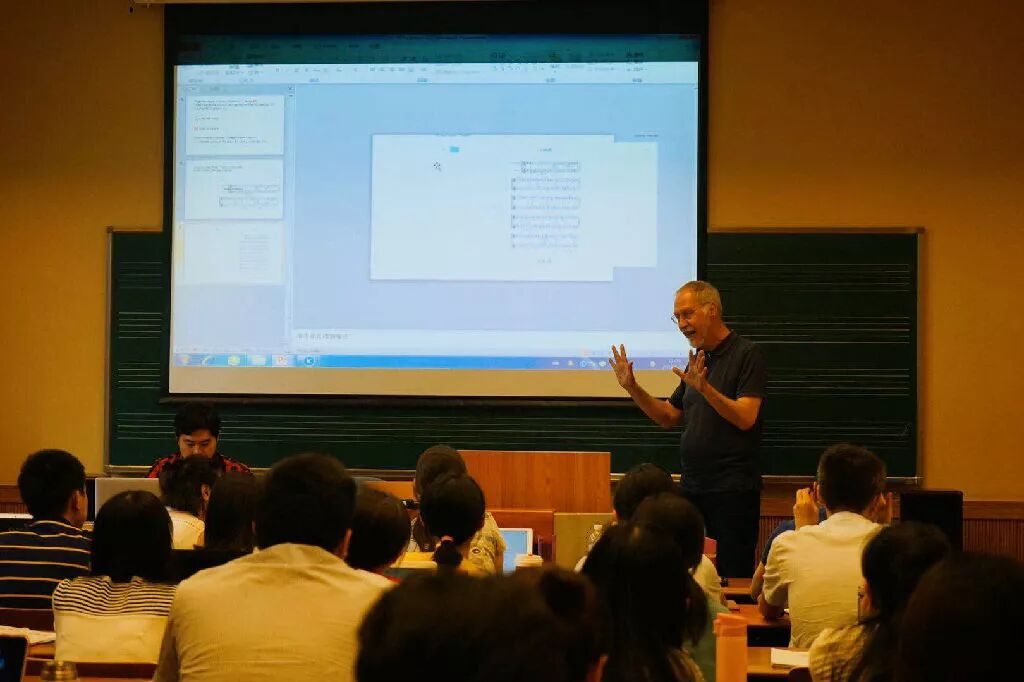
哈斯蒂教授在上音讲学(2018年6月)
当然,西方作曲家能够在中国新音乐中找到许多有趣且有价值的东西,但我更想探讨的,是一个据我所知并未被广泛谈及的话题。
简言之,我认为,通过聆听和思考过去40年间的中国新音乐,可以使我们获得一条反观西方音乐文化局限性的途径。这种“局限性”,源自于欧洲现代主义者对历史或传统的恐惧。
需要声明的是,我所说的“局限性”并不具有消极的意味。具备意识到局限性的能力也是成长的一种方式。限制不一定代表止步不前,恰恰相反,它预示着我们可以找到跨越的边界。向前一步,我们将迈入一个更为广阔的新世界。换言之,感知这种“局限性”可以让我们从一些全新的视角对自身文化进行更为深入的审视,进而使其得到更新,保持新鲜活力。感知自身文化局限性的方法就是去深入体察另一种文化,然后找到彼此间的差异。如果能够通过对文化差异的认知去修正自身的文化,将受益无穷。实际上,于我而言,这也是一种文化融合的好方法。
令我感到惊异的是,中国新音乐与欧洲或“西方”新音乐之间一个非常重要的区别,在于它们传统文化艺术价值观上的不同。我知道,这种比较可能会引起人们对于战后西方音乐传统的深切忧虑。但这种不同是可听可见的,因为无论是当代中国音乐还是欧洲音乐,都可以看做是“新音乐”的一个分支,即一种以使用通用的且易于共享的记谱技术来界定的国际性创作形式。正是这种共性使得比较并感知不同成为可能——不同种类的新音乐,使音乐保持新鲜活力的不同可能性。凡此种种,多多益善。
作为展开这一论题的宏观背景,请允许我简要讨论一下欧洲新音乐中的反传统主义。“新音乐”(德语die neue Musik)泛指现代主义、先锋派和实验音乐,其历史进程从20世纪的第一个十年延续至今。这些音乐实践既是对欧洲古典音乐传统的延续,又是对它的扬弃。新音乐从一开始就明确表现出对19世纪“浪漫主义”思潮的反叛。意味深长的是,19世纪浪漫主义从其诞生之初就具有鲜明的革命性。而自法国大革命以来,“革命”一直是“新”的重要内涵之一。
20世纪初叶,音乐生活中就存在着多种形式的对抗乃至反叛,其中一些甚至具有国家竞争的色彩。例如,德彪西、拉威尔和斯特拉文斯基等人便刻意与德国浪漫主义传统划清界限。但是他们却沉迷于此前的欧洲音乐,同时热衷于异国情调的“东方”音乐。交织着对这些传统的爱慕与嘲讽,甚至在我们看来还有些许的幼稚,他们创造出了充满活力的新音乐。
另一方面,德奥音乐家们则进入了更加抽象的领域。尽管勋伯格和韦伯恩声称他们与莫扎特、勃拉姆斯和马勒保持着密切的联系,但他们发展的无调性音乐,最终令斯特拉文斯基的新古典主义看起来是无可救药的“幼稚”。同时这也迎合了诸如阿多诺等人本应被规避的政治保守倾向。这种抽象化的转型,特别是韦伯恩的十二音体系,似乎开启了一条前往新世界的通道,一个远离传统织体、和声、旋律和节奏的新世界。这个新世界中,原有体系中的概念都会受到质疑,甚至连“体系”本身亦不能幸免。
第二次世界大战是这一切发生的转捩点。于欧洲人而言,1945年之后所谓的“新音乐”变成了一种对传统的、复杂的、革命性的和极度理论化的否定。这种否定不容置疑。它发端于惨痛的双重创伤,发生在“二战”造成的恐怖毁灭之后,加之此前“一战”(1914—1918)所导致的令人心有余悸的肉体和精神上的伤害。这在战前的乌托邦乐观主义情绪的映衬下尤其令人震惊和生厌。
20世纪40年代,对于很多艺术家和知识分子而言,欧洲历史不啻为一场噩梦。想要从这噩梦中醒来就意味着要忘记、逃避,或者去寻求一种乌托邦式的解脱,做一次没有过去的飞行。总之,那段历史必须从记忆中被抹去。在此,必须强调的是“乌托邦”的吸引力。乌托邦归根到底是抽象的、想象的世界,这个世界致力于逐步消除差异和摩擦,以便实现完美的统一。顺便说一句,现代英语中的“乌托邦”一次来自于古希腊语,意思是“不存在的地方”(no place)。如果乌托邦是高度抽象的王国,那么“不存在的地方”用数学几何空间来表示就再恰当不过:这是一个可以被想象成同时包含所有可能形式的空间,冲突终结、完美自由、正义达成。对于音乐来说,每次的向前发展似乎都是通过否定传统来达成自我的升华。对于旧有的和声、旋律、曲式、节奏等技术的消解都是经过深思熟虑的,而且所有的这些创作“技术”特征都与强大的记谱技术密不可分。当然,也有一些激进的尝试将记谱法转化为个性化的艺术,甚至使之完全消泯。但在大多数情况下,记谱法仍在不断发展。创新使得记谱法不断完善并更加灵活,在一些案例中,记谱甚至成为了创作革新的推动力。如果我们以更严格的眼光去看待抽象的“数学”系统,并将其作为记谱法的一部分,那么记谱的创新往往被证明是作品创造和声音变化的驱动力。
西方的记谱天才们已经创造出一种非常精确的时间关系标记法,从而能够让人们在同时演唱或演奏不同的音乐时协调一致。罗德教授在他的演讲《和声中的声部线条:近期中国四部音乐作品中的声部协作类型》中,就展示了我们的作曲家是如何巧妙地创作并运用了这样的“复调音乐”。我坚信,这种记谱技术的产生、发展乃至今后的存续都可被视为欧洲音乐最卓著的成就——一项无与伦比的成就。
从20世纪初的新音乐开始,节奏标记便首先以激进的方式改变并打破了已有的规则,作品中拍号的频繁变化是对传统最明显的突破。节奏的中心地位是显而易见的,因为时间的控制和协调是西方记谱法最为主要的创新。终于,西方记谱法的激进创新清除了传统音乐中有关音高和节奏的大部分痕迹。清空其标记中的内容就代表着是清空传统的声音信息。通过这种方式,新的记谱方式似乎可以表现任何内容。
事实上,与欧洲传统相反的是,新音乐对欧洲古典文化领域之外的传统始终张开怀抱,这就为记谱法的发展提供了更多可能性。以当今的记谱技术,几乎可以创作出能在任何乐器上演奏的任何可能的声音。由于记谱法的特质,声音的产生可以伴随着极其丰富的速度与节奏的细节。新的记谱法可以表现任何的音乐文化。这难道不是非欧洲的作曲家们参与全球音乐文化的机会吗?亦或这种包容或封闭其实是一种殖民化,是近代(16、17世纪)欧洲所梦想的通用的语言,是一种普遍科学(拉丁语mathesisuniversalis)?毕竟,更有价值的是欧洲音乐的传统,而不是对记谱法卓越的、无与伦比的力量的扩展。
我不认同全球化音乐文化的观点,因为这意味着差异的消泯。谁会喜欢被消泯呢?如果没有了差异,殖民化的空间将大大扩展。相反,我更愿意进行比较,这样比较中的双方便都获得了存在的价值。在我们进行的两种新音乐的比较中,中国新音乐展现出的对于传统更大的开放性令我十分赞赏。我确信,这种比较将有助于揭示或理解西方音乐中的那些焦虑和压抑,以及对审美和反叛既有规则的禁忌。在最权威的欧洲(和泛欧主义)新音乐中,所有对于节奏、调性中心、全音阶、旋律、主题发展乃至对过去音乐的明确引用,都因被视为难堪、幼稚且陈旧而受到抵制。有些作曲家会利用这些资源,但由于没有朝着既有的“新”方向前进,而承担着被视为圈外人士的风险。有些圈外人也取得了成功,但并没有像萨尔瓦托雷·夏里诺(Sciarrino)和赫尔穆特·拉亨曼(Lachenmann)那样能够创作出如此之多的新作品。例如,阿沃·帕特,他独具匠心地重新构想了中世纪和文艺复兴时期东西方的宗教音乐。
就中国新音乐而言,我感受到的是一个与传统的疏远程度似乎小得多的不同世界。我知道,21世纪的中国历史和传统都充满了挑战性,所以我并不想使这个问题简单化,但是在中国新音乐中所感受到的开放性和自觉性的确让我耳目一新。似乎我所听到的大部分中国新音乐都充满了想象力,想象力的价值和自由度都得到了充分重视。如果你愿意,被释放的想象力可以带你恣意翱翔。它们或许涉及节奏,或许有潜在的调性中心感,或许运用了五声性的音响效果,亦或许与民间音乐相结合,但你都无需抗拒。当然,你需要知道如何富于乐感且诗意地去运用这些元素,而不是害怕和抵制它们。另外,你也不必沉溺其中,更不必去特别专注某个元素,例如创作一首仅仅关于节奏或关于五声性音列的作品。
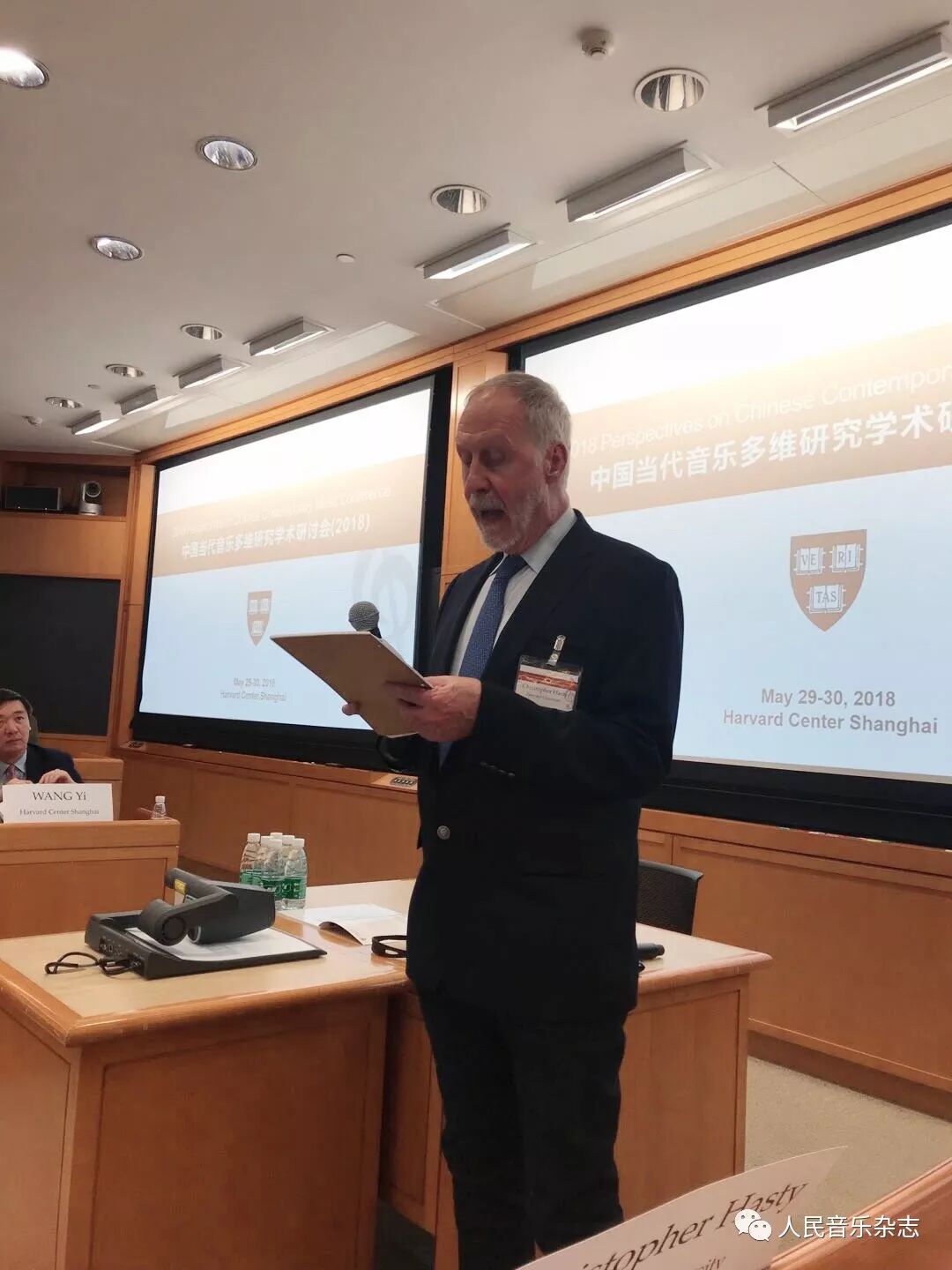
哈斯蒂教授发言
以参与本次会议作曲家们的创作为例。高为杰可以运用无调性音列来突出或隐藏调式和五声音阶的音响效果,他可以在规则与不规则节奏之间快速转变,并且可以自如地运用或规避中国传统元素。梁雷可以像书法大家的笔触一样通过一条“单线”去实际展示复调的细节,进而以一种易于理解的方式向观察者展示线与面间相互融合协作的秘密世界。他的线条性复调可以与抒情歌曲产生共鸣,也可以转向一种文化中立的自然主义。贾国平不仅使用了规则与不规则的节奏律动,而且以非常实用的方式重新塑造了节奏标记,似乎没有他不愿意探索的声音世界。在所听过的贾国平的作品中,我甚至发现了可与拉亨曼比肩的创新,但这种创新通常建立在人类对于歌、舞、戏剧以及思想的共同感悟的基础之上。贾达群是一位结构主义大师。他擅长将生动且极具特色的音响世界进行编织组合,并将之与社会和政治相关联。我很感谢他寄送给我们他的作品。他有着作曲家与理论家两种截然不同身份,在他的作品中展示了于这两个领域之间自如转换的才能。另外,虽然向民没能参加我们的会议,但是他将其美妙作品《古典印象》寄给了我们。这是一首用对位法为民乐和民歌创作的结构严谨、富于创新性的复调作品。
正如这些作曲家所呈现的那样,免受约束且自由使用自己喜欢的素材,加之匠心独运的精雕细琢,进而展现出高超的创造性。相比而言,西方现代主义文化中往往是焦虑有余而自由不足。或许焦虑可以产生伟大的艺术,即便如此,我们也应该期盼拥有更多元的艺术——焦虑、快乐、真实和超现实并存,以及使不同艺术相互融合的机会。艺术本就应该百花齐放。
最后,两种新音乐在与其传统文化接触的途径存在相当大的差异。我目力所及的中国作曲家,都延续了艺术一体的古老传统。通过这种方式,音乐始终与绘画、书法和诗歌紧密相连。音乐通常反映着一种既有的影象或叙事。我认为,这是一种奇妙的天赋,这种天赋在欧洲遗失已久,在北美甚至从未出现过。相比之下,西方音乐与其姊妹艺术的隔阂已构成一种巨大的局限。这种中国传统的天赋可能无法向西方转移。如果可以做出选择,我认为用这种古老的传统来交换记谱法是非常可惜的。但若能兼而有之,何乐而不为呢?
行文至此,我希望能以一位作曲家的身份来表达我的感激,通过了解中国新音乐,使得我能够以一种更少顾虑、更为自由的状态投入创作。或许我可以将这种“感激”总结为:对于他文化的“借鉴”并不是有害的。“借鉴”的另一种表述是“接受馈赠”。这种馈赠无所不包,可以是强大的技术,可以是令你更清楚看到自身文化局限的洞察力,它将带你进入新的疆域,不断成长。
基金:哈佛中国基金(Harvard China Fund)《中国当代音乐多维研究》(Perspective on Chinese Contemporary Music)成果; 上海市曙光人才计划项目《音乐文本分析与符号学跨学科研究》成果,项目编号:15SG26。
基金项目:教育部人文社会科学重点研究基地重大项目《中国专业音乐创作与传播未来发展研究》,项目批准号:16JJD760003。
(本文原载于《人民音乐》2018年第9期)
克里斯托弗·哈斯蒂(Christopher Hasty) 哈佛大学音乐系教授
译者:张萌 《人民音乐》杂志副主编
排版:盛汉
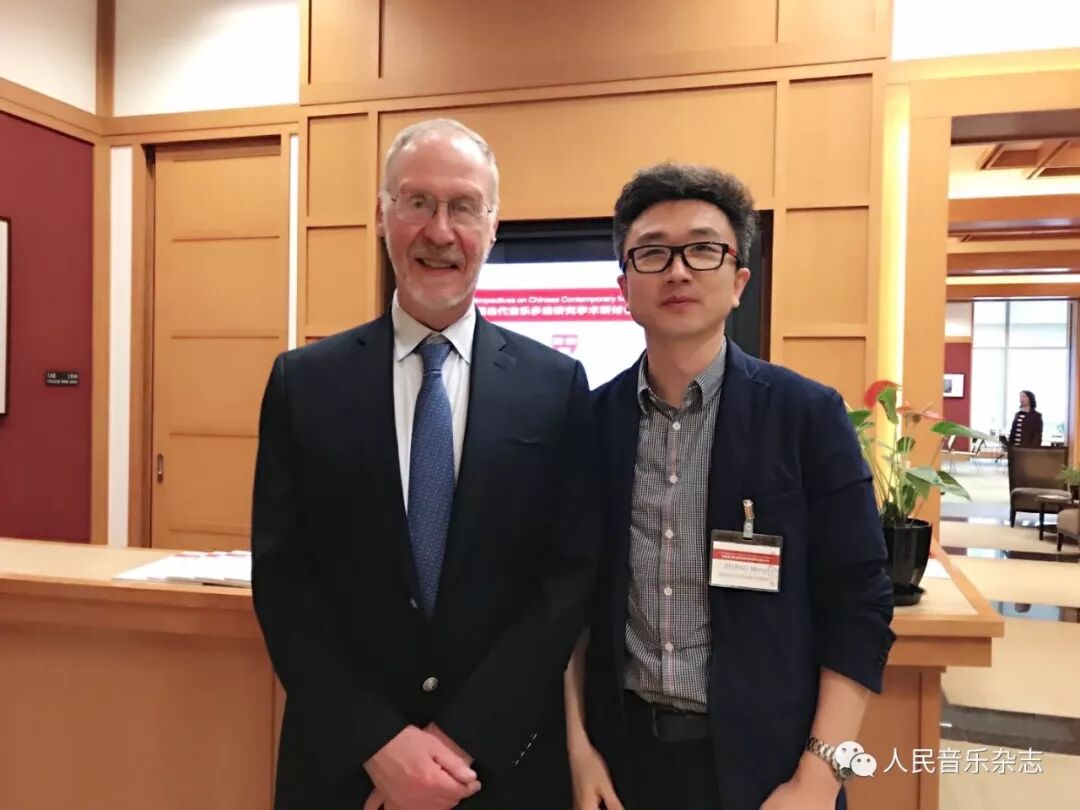 本文作者哈斯蒂与译者张萌合影
附原文:
Thoughts on an Importance of New Chinese Music for Western Composers[1]
Christopher Hasty, Harvard University
I speak to you here still at very early stages of learning about Chinese music. And I am grateful to be so warmly welcomed as a visitor. So please take these “thoughts” as initial impressions.[2]
Of course, there are very many things western composers could find interesting and useful in New Music from China, but I would like to consider one thing in particular that, as far as I know, isn’t widely discussed.
To put it simply and briefly, I suggest that thinking about and listening to Chinese music of the past 40 years or so, could be a way of gaining some insight into limitations of western musical culture. The limitations I would like to call attention to come from a European-modernist fear of history or tradition.
Please understand that by “limitation” I don’t mean something negative. The ability to see limitations is a way to grow. A limit does not have to be a stop; rather, a limit might be a boundary to be crossed. And to cross a boundary is to enter a new and larger world, a world that to be new and larger, must be different. More specifically, sensing a limitation of your own culture can give you increased understanding and open new perspectives that can renew your own culture, and can thus help to keep your world fresh and new. And the way to sense limits of your own culture is to really sense another culture and its difference from your own. Thus, there can be great advantage in being able to use your hearing of cultural difference as a way to become more attuned to your own culture. (Indeed, this seems to me a good way of mixing cultures.)
What strikes me as an especially important difference between New Music of China and European or “western” New Music is the difference of value given to tradition in the two artistic cultures. I believe the comparison can bring into focus deep anxieties concerning tradition in post-war western music. This difference is made audible and visible by the fact that contemporary Chinese and European musics are each a form of “New Music,” a kind of international style defined largely by using common and easily sharable technologies of notation. It is this commonality that can allow for comparison and a feeling of differences – different kinds of New Music, different possibilities for keeping music new and alive. The more possibilities, the better.
So, this is my thesis. To give some background to support this thesis, let me begin by briefly discussing the anti-traditionalism of European New Music. “New Music” (in German, die neueMusik) refers broadly to modernist, avant-garde, and experimental musics dating from the first decade of the 20th century and continuing to the present day. These practices emerged as both continuations and rejections of Classical European music traditions. From the start, the New Music showed resistance especially to 19th-century “Romantic” practice. (Interesting, by the way, that 19th-century Romanticism itself began as explicitly revolutionary. Indeed, revolution has been a theme of the “New” since the French Revolution.)
Around the beginning of the 20th century there were many forms of musical resistance and even rejection. Some were colored by national rivalries. For example, Debussy, Ravel, and Stravinsky distanced themselves from traditions of German Romanticism. But they were nonetheless happy to play nostalgically with earlier European music (and play too with exotic “eastern” music). And often with a mixture of affection and irony (and, from our perspective, naivete), they were able to use these traditions to create vibrant new music.
On the other hand, the Germans and Austrians were moving leftward into much more abstract realms. Although Schoenberg and Webern claimed a strong connection to Mozart and Brahms and Mahler, they developed an atonality that would eventually make Stravinsky’s Neo-Classicism seem hopelessly naïve and according to some (for example, Adorno) politically reactionary and deserving to be shunned.From this move toward abstraction, especially Webern’s 12-tone music seemed to offer an opening to a new world, a world far from traditional gesture, harmony, melody, and rhythm. It was a world that would put such categories in into question, and even question the traditional notion of “category.”
The turning point was the Second World War. For Europeans, the so-called “New Music” after 1945 came to be a complex, revolutionary, and extraordinarily well-theorized denial of tradition. This denial made perfect sense. It was motivated by a cruel double-trauma. It came in the wake of the terrible destruction of the Second World War preceded by the shocking physical and spiritual devastation of the First World War (1914-1918), especially shocking and sickening in view of the utopian optimism that preceded the war. (A small cell of that optimism survived the war, and in the war’s wake carried out a revolution that blossomed into the USSR.)
By the1940s, for many artists and intellectuals European history had become a nightmare. And to wake up from this nightmare would mean to forget, to escape this history and perhaps to seek a utopian liberation, a flight to not-past, a past of what must be forget. It is important to here to note the attraction of an utopia. An utopia is ultimately the world abstraction and imagination, a world that works toward the progressive elimination of difference and friction in order to move to a more perfect unification. Incidentally, “utopia” in modern English is borrowed from ancient Greek and means “no place.” If utopia is the realm of high abstraction the sense of “no-lace” would best be represented by mathematical-geometrical space, an ideal space that could be imagined to contain all possible forms at once (and promise an end to strife, a perfect freedom, justice). For music, it seemed that the way to move forward was to purify itself by negating tradition. The elimination of the old techniques of harmony, melody, form, and rhythm was carried out thoughtfully and meticulously. But it is important not to separate these various “technical” compositional features from the powerful technology of musical notation. There were, in fact, also marginal attempts to turn musical notation into its own sort of art, and there were many efforts to eliminate notation altogether. But for the most part, notation thrived. Innovations allowed notation to be expanded and to be made more flexible. And in some cases, notational change was the driving force for compositional innovation. If we were to regard abstract “mathematical” systems more strictly, as part of notation in general, then notational innovation would very often prove to be the driving force for compositional creation and sonic change.
The genius of western notation has been its ability to specify very exact relations of timing in the coordination of people singing or playing different things at the same time. (Professor Roeder has shown in his lecture yesterday how artfully our composers here have composed and notated such “polyphonies.”)[3] I believe the development of this notational technology was and remains the most remarkable accomplishment of European music. Indeed, it is an unparalleled accomplishment.
From the beginnings of New Music in the early 20th century, it was rhythmic notation that first changed in a radical way, breaking with the conventions of the past. Frequent changes of meter signature within a piece was the most obvious break with tradition. The centrality of rhythm is not surprising since timing and coordination of timing was the primary innovation of western notation. Eventually, the radical innovations of western notation were able to eliminate most of the vestiges of traditional music, pitch as well as rhythm. It’s as if the form of western music, it’s notation, could be emptied of its content, that is, emptied of the sounding stuff of tradition. In this way, it can seem that the new notation-form is now available for any content.
Indeed, in its opposition to European tradition, New Music has opened notational possibilities that can invite the participation of traditions outside the European classical cultural sphere. With current technologies of notation, virtually any possible sound, on any instrument, can be produced. And because of the genius of notation, sounds can be produced in great rhythmic or temporal detail. With the new notation any musical culture can be represented. Is this an opportunity for non-European composers to participate in a global musical culture? Or is this inclusion or enclosure a sort of colonization, and a fulfillment of the modern (16th- and 17th- century) European dream of a universal language, a mathesisuniversalis(Latin)? After all, what could more honor the tradition of European music than an expansion of the remarkable, unequaled powers of its notation.
I do not much like the idea of a global music culture because this idea would tend to smooth out differences (who likes being smoothed out?). Without differences I think there is too much room for colonization. Instead, I would prefer to make comparisons in which neither term of the comparison would be privileged. And in the comparison of our two types of New Music, the difference I am personally drawn to is the comparative openness of Chinese music to tradition. I believe that this comparison can help to shed light on anxieties and repressions in western music, taboos against what is permitted, the taboos of taste. I would say that in the most prestigious European (and Europeanist) New Music, pulse, tonal center, diatonicism, melody, thematic development, and explicit references to past music are resisted as embarrassing, naïve, and not new. Some composers do work with such resources; but then they risk being treated as outsiders, not moving in the long-standing direction of the New. Some of these outsiders have been very successful outsiders, but have not been sources for new work in the way Sciarrino and Lachenmann have been. Think, for example, of ArvoPärt who sincerely and beautifully re-imagines Medieval and Renaissance sacred vocal music East and West.
In the case of Chinese music, I sense a different world in which there seems far less alienation from tradition. I don’t want to oversimplify; I know that history and tradition are challenging in 21st-century China. But I sense in Chinese music an openness and spontaneity that I find refreshing and exciting. It seems that in much of the new Chinese music I’ve heard there are fewer restrictions on the imagination, and indeed an explicit valuing of imagination and freedom of imagination. Imagination freed takes you where it will, if you are willing to go there. If this involves pulse, or a strong underlying sense of tonal center, or if it involves a pentatonic sonority, or an encounter with folk music then you don’t have to resist. Certainly, you have to know how to work with such things musically and poetically, but you don’t have to fear and resist them. And you don’t have to obsess about them by focusing on one or another; for example, by making a piece just about pulse or just about permutations of pentatonic sets.
Gao Wei-jie can use atonal sets in ways that bring out or hide modal and pentatonic sounds. He can move rapidly between pulse and the absence of pulse. And he can move freely in and out of Chinese traditions. Lei Liang can open up an apparently “single line” to an actual polyphony of detail in much the way the master calligrapher’s line, on inspection, will reveal a secret world of coordinated lines and planes working with and against one another in a comprehensible way. Lei Liang’s line-polyphonies can evoke song and can also move to an apparently culture-neutral naturalism. JiaGouping plays not just with pulse and non-pulse but with rethinking rhythmic notation in very practical ways. And there seems no sound world he is not willing to explore. In the pieces I’ve heard, I find a level of invention comparable to that of Lachenman, but often grounded in the human feeling of song and dance and open to drama and wit. JiaDaqun is a master of weaving together and juxtaposing vivid and highly specific tonal worlds that are often close to the social and political. I appreciate his choice in sending us this pair of pieces. JiaDaqun has the further distinction of working as a composer and explicitly as a theorist, and in his work he has demonstrated the advantages being able to move between these two worlds. And, although he wasn’t able to attend our conference, Xiang Min sent to us his beautiful “Impression II,” a formally and contrapuntally innovative polyphonic composition for Chinese instruments woven out of strands of folk song.[4]
The freedom from constrain, the freedom to use what you like, can be highly creative when it is used with craft and cultivation, as it is here in the case of all our composers. In western modernist culture I would say there is less freedom and more anxiety. It may be that anxiety can produce great art. But even if that is true, we should want to have many kinds of art – anxious, joyful, real and surreal – and also opportunities for mixing kinds. How many kinds of art are there?
Finally, there is a very deep difference between the two New Musics in terms of the access each has to tradition. All the Chinese composers I know continue an ancient tradition in which the arts are united. In this way, music is never separate from painting, calligraphy, and poetry. Music is always, already image and story. This is, I think, an amazing gift (something long lost in Europe and something we’ve never had in North America). By comparison, western music’s isolation from its sister arts is a great limitation. This gift of Chinese tradition is perhaps not transferrable to the west. If it came to a choice, I think it would be a pity to trade this ancient tradition for notation; but if you can have both, why not?
In closing, I would like to express my gratitude as a composer who has felt much freer to use what I like, and with less anxiety, as a result of my exposure to new Chinese music. I include this note of gratitude to make a closing observation: “borrowing” from another culture need not be appropriative and harmful. Let’s say, instead of “borrowing,” “accepting a gift.” There are all sorts of gifts. There is the gift of a powerful technology and there is the gift of cultural insight, of being able to see more clearly the barriers of your own culture and to envision a wider world, and to grow.
NOTES
[1] Concluding speech from the international conference “Perspectives on Contemporary Chinese Music” held in Shanghai, May 29-30, 2018 at the Harvard Center.
[2] Reference to John’s Conference paper
[3] John Roeder’s lecture, “Lines in Harmony: Types of Cooperation in Four Recent Chinese Compositions,” has been translated into Chinese and will be published。.
[4] Prior to the conference, the four invited composers – JiaDaqun, JiaGouping, Lei Liang and Xiang Min – submitted pieces for the other members of the conference to get to know in preparation for our meeting.